"Welcome to Crest of a Star; these maps and other graphics are only for playing D&D type games. They are copyright and not to be used for other purposes. If you have them on your site, please remove them. Thank you."

"My maps are free. If you purchased them, you got scammed."
"Not for redistribution or resale. Hyperlinking from Pinterest or other such share sites is prohibited."


Posted

Some Links

  1. quarrel: This crossbow missle was developed from the bolt and designed to reduce the chance of its glancing off of heavy armor. It had a heavy four-sided metal head, usually with a small sharp point on each corner.

  2. qv or qqv: Which see; something which is also referenced.

  3. Ram: A heavy beam swung from a massive covered timber framework or a smaller version carried by an assault group. Because it had little affect on thick masonry walls, it was repaced in Age 10 c. year 500 with the trebuchet (qv).

  4. Rampart: In a motte-and-bailey (qv), it is a broad earth work with a palisade along its outer edge; in stone, it is the top of the curtain (qv).

  5. ransom: money or goods to pay for the release of a character that has been captured by enemy forces.

  6. real: Something a game will never be.

  7. Referee: The person in charge of running the game, an arbitrator who has the ability to give binding decisions. But I’m not an arbitrator type of referee.

  8. Reincarnation: Bringing a game character back to life by magical means into another body, not necessarily the same race but not a radically different alignment.

  9. Resurrection: The revival of a game character, after its death, by magical means in the character’s original game body. Cost: about 5,000-7,000 gp. Fireball victim: up to and includung 20,000 gp.

  10. Retinue: A character’s personal following, i.e henchmen, hirelings, or servants.

  11. Riders of Seela: Women cavalry in groups of 7-19 riders. No one seems to know where, or when, they come from. They roam Crestar (qv). Sometimes they are at a gallop going somewhere fast, and sometimes they will stop to chat. They first appeared on the scene c. Age 10, year 700 after the Undead Hordes had ravaged these lands. Harassing them is as dangerous as harassing a Green Guild messenger.


  12. Royal Fifth: a percentage of something. As for adventurer treasure, it is 25 percent. More if the King sees something Really Pretty.

  13. Rubble: Coarse and uncoursed material used for infilling a curtain wall. Or all that is left of a castle, broken stone.


  14. Sappers: Sappers dig approach trenches or tunnels towards a castle being beseiged, while miners dig the tunnels under the castle walls.

  15. Saving throw or roll ( also SR): A die roll which is used in adverse circumstances to determine the efficacy of a spell, whether a character fell into a pit or not, whether a character escaped a dragon’s breath, etc. House rule: Some SRs are made using 4d6 rolled against a particular ability number; such as dexterity, intelligence, or wisdom. This is done if I felt a player character was doing something that challeneged that character’s abilities.

  16. Scaling ladder: A ladder used to assault a castle wall.

  17. Segment: The smallest unit of combat time in this game; equal to 6 game-seconds.

  18. Shell-keep: Masonry building competely surrounding the summit of a motte or revetted against its lower slopes.

  19. Shutter: Movable device for closing the crenel or opening in a wall to give the defenders added protection. Sometimes made of metal, more often of wood.

  20. Sites, reused: A number of castles occupy previously fortified sites, occasionaly prehistoric.

  21. Smiths: Responsible for the manufacture and repair of domestic and military iron work. Also sharpens weapons and tools.

  22. sp: Silver piece(s), a monetary unit. 20 sp = 1 gp, 100 sp = 1 pp.

  23. Squire: A person that becomes a page as a young child; when promoted to squire, works for a particular knight as body-servant, guards prisoners, carrier of spare weapons, etc.

  24. structural points: The amount of damage a structure can take before it falls down.

  25. Surprise: Both parties in an encounter must check to see if either or both are surprised, which may result in a loss of initiative (qv).

Author
Categories Crest of a Star, glossary

Posted

Some Links

  1. Tiltyard: A yard, field, or enclosed space for tilts and tournaments; and preperation and training exercises. A tilt is a combat exercise or sport between two mounted knights.

  2. Time, building: Building is seasonal and usually excludes winter months. The time involved in the erection of a castle could vary from a few weeks for an earth and timber one to the same number of years for a masonry structure.

  3. Tournament: Aristocratic entertainment and display. Its principle feature is the mock battle.

  4. Tower: Similar to a keep, they were built into bailey walls for greater protection around Age 11, year c. 10. At first they were only put at corners, because this left the middle of the curtain wall vulnerable, wall towers were added. These wall-towers are usually D-Shaped. Thus presenting their curved wall to the attacker; Age 11, year 306. Some places presented the curved wall to the interior, found mostly on ruins, the reason is unknown.

  5. Town and castle: The earliest castles, motte-and-bailey, seem to have been placed to control neighboring towns, rather than protect them ( Grog; Age 10, c. year 40). Settlements grown up in the shadow of a castle where there was no town before, e.g. Fondfield and Dwarfbas.

  6. Town gates: Provision varies to whether a town was a thoroughfare on lines of communication or a cul-de-sac pathway. Some town’s gates are barbicans (qv) instead of gatehouses or simple gates.

  7. Town walls: Fortified towns, with palisades, is the first ‘castle’ type. The first use of stone walls is uncertain, but was common by Age 11. Some town walls have been constructed so as to form the outer bailey of a castle and its inner bailey.

  8. Trap: Any of a numerous mechanical or magical devices which may be triggered by adventurers, usually causing damage to one or more of them. Some traps only reroute a group of adventurers rather than damage them. e.g. pits, pits with spikes. poison needle taps on treasure chests, falling stone blocks, false doors, teleport rooms and chambours, identical rooms, elevator rooms, elevator rooms connected to ‘Gates’ (qv), etc.

  9. Trebuchet: A great and much improved siege-engine first used in Age 10 to assault the capitol of Liciera. The basic design, many variations exist, is a long arm pivoting on an axle at the summit of a high frame. The shorter end carried enormous containers of earth and rubble weighing many tons. Lead was sometimes used as a counterweight. The longer end, called the verge, is winched down to ground level against the counterweight’s pull by a large system of winches. This end carried the projectile in either a spoon or sling, which when triggered, hurled its charge in a high trajectory. The range is adjustable by moving a calibrated counterweight on the longer arm. The standard ammunition can be arched as far as 480 yards and a minimum range of 240 yards. Firing rate is once every four rounds with a well trained crew. A ballista (qv) can cover the trebuchet’s ‘dead range’ area.

  10. Trick: A device or machination which is more likely to be solved by wits rather than by force of arms.

  11. Turret: A small tower. Sometimes placed on top of a larger one to provide a lookout point and also to cover the stairhead leading to the keep.

  12. Turn: a unit of game time; equal to 10 game-minutes.


  13. Undead: A group of malevolent souless monsters which are not truly dead or alive. They include, but are not limited to, skeletons, vampires, ghosts, zombies, ghouls.

  14. Undead Hordes: An army of undead which destroyed Licieria. Large numbers of liches were involved.


  15. Village Enclosure: Sometimes an earthen embankment provided some protection. About Age 4 timber palisades came into use.


  16. Wall construction: Where possible foundations went down to bedrock quarried flat to receive footings. A rock and mortar outer course is laid down with the interior of the wall filled with rubble (qv).

  17. Wall towers: Towers placed along the curtain (qv) to give additional protection. They were square in the early Age 11; hexagonal towers were introduced about Age 11, year 200; and round towers came into usage in Age 11, year 302.

  18. Water gate: gave access to river or sea and thus to communications which were difficult to cut even during a siege. Most are designed to facilitate provisioning but they could admit reinforcements or provide a means of escape.

  19. Water supply: Water supply is usually inside the castle to prevent it being cut off from the castle folks or from being poisened. Many castles have a cistern system along with a well (qv).

  20. Well: An essential feature and there maybe more than one. Wells are covered with a well-house usually near the kitchen. Some dug wells reach depths of 150 feet.

  21. Wooden tower: The tower crowning earliest mottes was wooden and elevated on wooden stilts.

Author
Categories Crest of a Star, glossary

Posted


Sharn-Nak Islands, Age 10, Year 500, Outer Ocean, 1,000 game years ago.

now called Tantalow’s Island Group in Age 11.

The large island was originally divided up into 3 areas of influence, with some areas disputed or under no one’s control. The two evil areas didn’t get along. The good area was a loose confederation of small villages.

Arms and some armor, bronze. Composite bows and arrows with flint or bronze points. Spears are either 5’ or 12’ long. Phalanxes are an unknown. A few leaders have chariots, they are very expensive due to a low horse population. Most warriors have scale, leather, or studded leather armor. Chain is possible, but so expensive that only national leaders can afford it. That means there are only two sets of chain mail, in bronze. The Confederation has no chain mail.

Cloth and pottery skills are wide spread and good quality. Flax is grown for cloth, some areas have sheep and use the wool.

Most of The Confederation can read and write, few in the evil areas can do so.

Square Keeps are stone towers, castles are motte-and-bailey with only some stone work due to the expense.

Some mining goes on, but smelter fires of this era can only make small quantities of any metal.

Some places have wagons, but most folks have to hand carry their goods. Some usage of dog travois.

Some food grains are grown, deer and smaller meat animals are in the various woods in large numbers. Sheep are prized for their wool, rarely used as a meat animal due to there being too few for them to be used as a dietary staple. Three meals of mutton a month would be a large quantity.

There is an uneasy semi-truce between the areas.

Some small amount of trade between the groups, but all trade is done in the disupted areas and armed guards always attend. The road in Tantalow’s Territory leads to 2 mines. Map png has been enlarged and updated

page 2 of text

large png, Sharn Nak Islands

Minerals:

Tantalow’s Territory has gold (Au), tin (Sn), iron (Fe) and silver (Ag).

The Confederation area has: carbon ©, gold (Au), and iron (Fe).

Ghaska’s Territory: none

Mountains outside the above areas: Copper (Cu) and gold, (Au). There have been armed skirmishes over the copper as it is need to make bronze. Sometimes the skirmishes are between miners, sometimes between military groups.


Author

Posted


Tantalow didn’t like sharing the island. He wanted it to be all under his control.

One day he developed a method for opening a magic Gate.

He should have worked on learning more about it and the possible worlds and planes he could contact.

He wanted to fool the newcomers, so he disguised himself as a 6’ tall bunny rabbit. To help them be unafraid.

Bad Idea.

The beings who came through loved to hunt.

Their strange weapons made loud noises, and fired high speed pellets.

Some of Tantalow’s subjects who were watching from a distance, slowly backed into the nearby forest. Others sounded the danger horns. Those horns were one of the few things common to all 3 groups. And used during major emergencies affecting all of them.

Didn’t do them much good.

The attackers went after anyone armed. Spell casters took out many of them. Then the Gate was closed. But not before a metal object came out, it had a moving turning gun. Larger than the ones carried by the invaders. It blasted a few places, then broke down. It was set afire with oil lamps thrown at it.

One group of the invaders threw round metal objects into the water near Tash Bay, to go fishing with. Minor earthquakes resulted.

Something, or several somethings, deep in the water cast mucus nets up onto shore and dragged some of the invaders into the sea. Larger explosives were tossed into the sea.

Archers of The Confederation took this opportunity to fire arrows into the invaders. Some died, but so did many of the archers.

Some Islanders fled by boat, some were spotted by the invaders. Some got out of range of the weapons, some didn’t.

The ones who fled to the Shaking Islands drowned when the islands sank into the depths.

Earthquakes rocked the island, knocking some mountains down. Another island rose to the surface over many months.

Suddenly bolts of lightning rained down from a clear blue sky. What was left of the stones making up the Gate vaporized. The nearby monolith ring was untouched.

The mountains on Splanto Island vanished. Some say they rose into the sky.

Over many years the original inhabitants once again rose from the ashes. Some went out to the new island and settled there. Some of the original evil inhabitants survived. Most of the good survived. None of the invaders.

Many a brave islander died setting traps or attacking the invaders with makeshift weapons. Some used their bare hands. Evil and Good cooperated against the common enemy. They were no longer so quick to attack one another, even after the common goal of taking out the other planet invaders was complete. Stories were told of their sacrifice for many long years.

As a reminder to not meddle in magic that can create Gates, they called the islands Tantalow’s Island Group.

Tantalow would be remembered, but not exactly like he wanted.


Notes on Shaking Islands:

Foundations out of sandstone and limestone. Ocean currents and wave action over the centuries had weakened their under pinnings.

The earthquakes shattered the sandstone, leading to the islands’ collapse into the sea.

Tantalow Island is a sea mount. The Shaking Islands were leftovers from the sea mount forming and were poised on one side of the sea mount. Not substantially connected to Tantalow, they barely hung there… just waiting for a strong earthquake or explosion to cause them to fall apart and sink into the sea. The invaders caused earthquakes that lost them forever. Down in the depths are bones, the goods, coins, armor, and weapons that haven’t rotted or rusted, of those islanders who fled the invaders.

The other islands are sea mounts not connected to Tantalow.

back to Tantalow’s Island Group


Author

Posted

Some Links

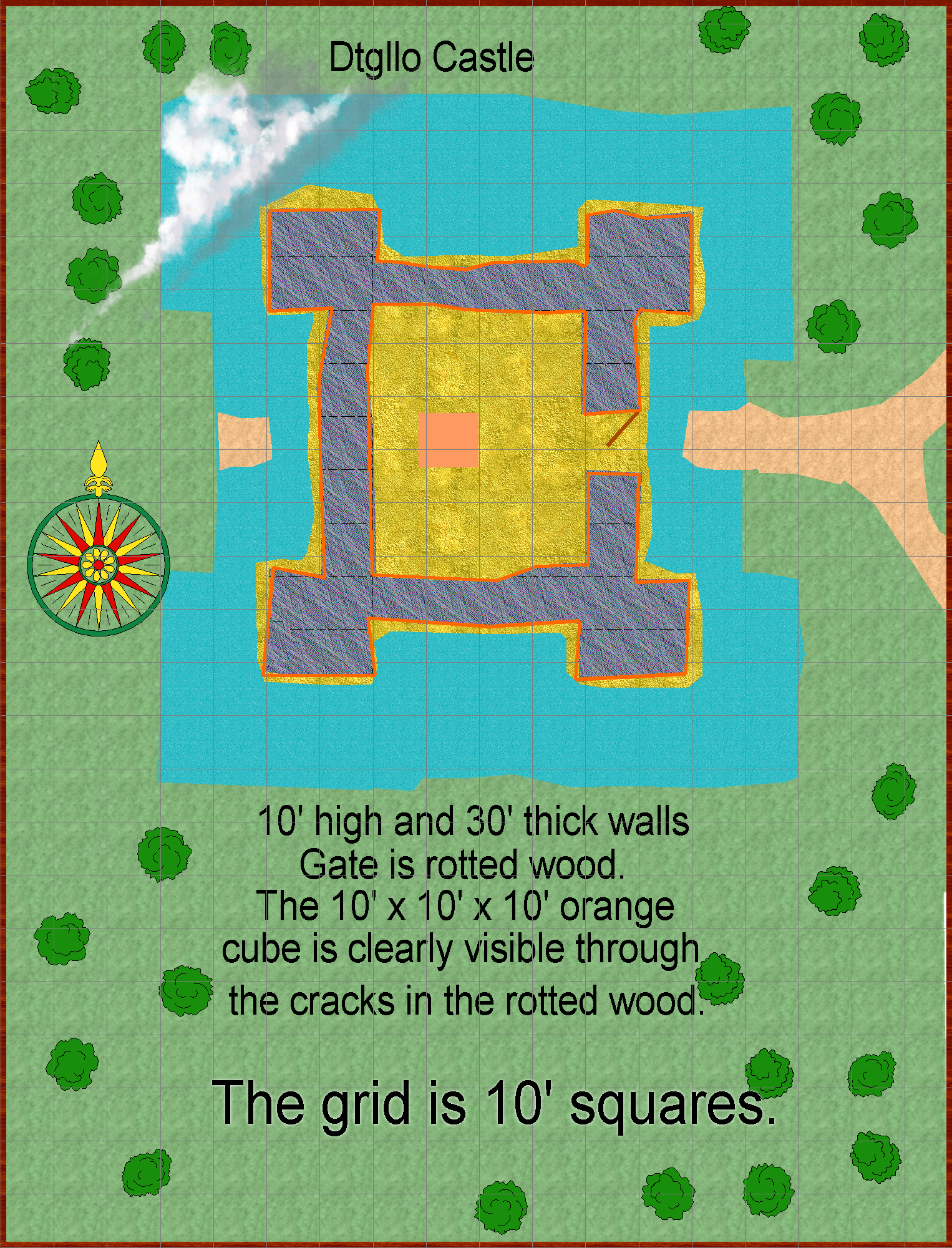
The castle is northwest of Hommlet. Its walls are 10 feet thick and 30 feet high. It looks like cut and laid stone, but its actually cut from one large block of stone. For the DM: The walls are not hollow, no passageways anywhere on the surface part of the castle.

The drawbridge leading out from land towards the gate looks old and decrepit. Its magical. To get it to close the gap, the magic words: ‘Close Sesame !’ should be spoken by one or more of the characters.

The gate door is of rotted wood. The characters can easily see the 10 foot by 10 foor by 10 foot orange cube.

Three crows are visible on one of the towers. After the party gets inside, one of the crows will fly over to the orange cube, land on it, and then be absorbed.

Only Holy Water and arrows harm the cube. Swords do it no damage and blunt weapons bounce. Treat the cube as if it has 20 hit points.

When all 20 hp are gone from the cube, it will dissolve revealing a 10 foot stair leading downwards at a 18.4 degree slope. It drops 30 feet in 10 feet horizontal distance.


Author
Categories South Hemisphere


Privacy policy: I track IP addresses and pages looked at out of a vague curiosity to learn what pages are looked at on my site. After a set period, this information is deleted. No personal information is permanently kept.


[ Copyright © by Jim, 1980-2050. All Rights Reserved. ]

[ Except where noted, and where copyrights are held by others. ]